
Poster Details
Poster Submitter: Alexis Roach, MPH
Department: Urban Health Initiative
Email Address: alexis.roach@uchicagomedicine.org
Role: Staff (non-nurse)
Project Lead: Alexis Roach, MPH / Urban Health Initiative
Project Collaborators:
- Elizabeth Hansen, MPH / Staff (non-nurse)
- Anna Marzano, BSN, RN, C-EFM, CBC / Nurse
- Mary Kate Wagner, LCSW CADC / Staff (non-nurse)
- Laura Markin, MPP / Staff (non-nurse)
- Abi Veld, MPH / Staff (non-nurse)
- Dameka Edwards-Hart, / Staff (non-nurse)
- Stacey Borelli, MSN, BSN, RN / Nurse
- Abbe Kordik, MD / Faculty
Departments Included in Project: Obstetrics, Other, Urban Health Initiative
Project Classification: Efficiency
Project Notes/Comments:
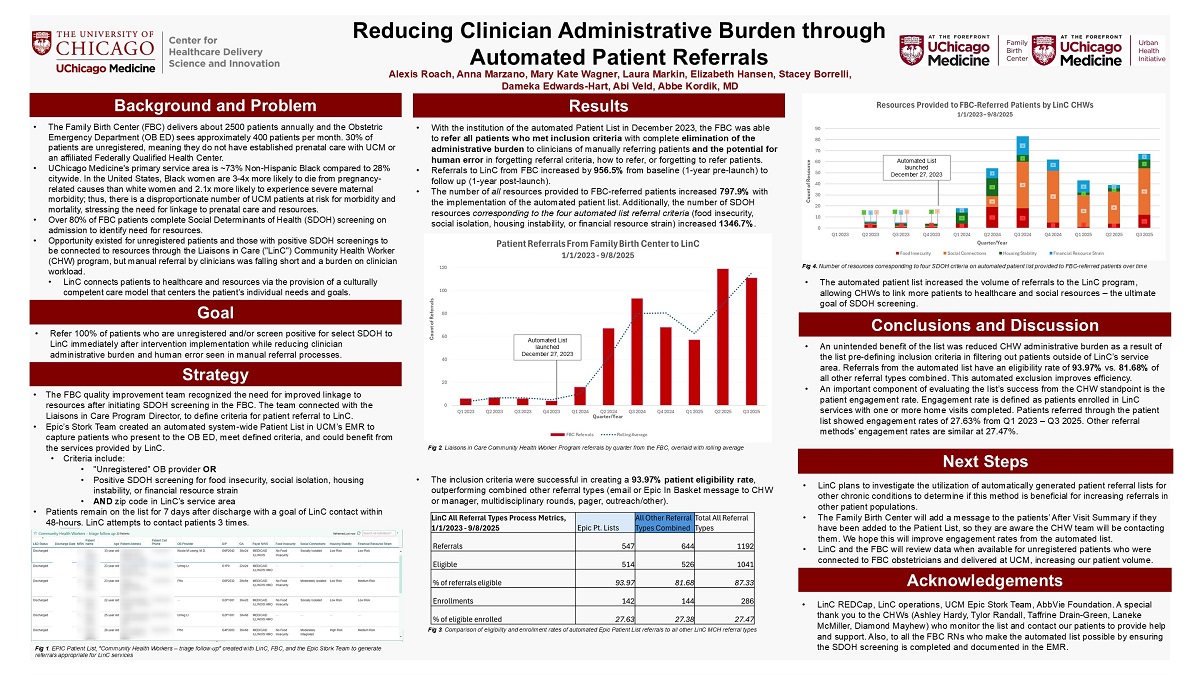
The reduction of clinician administrative burden and human error seen in manual referral processes, as well as the reduction of referral screening placed on CHWs in the recruitment process - saves significant time identifying patients in need of services and is thus, an efficient intervention.
Does the work incorporate equity?
This intervention took the Family Birth Center (FBC) Social Determinants of Health (SDOH) screening from equal care (every patient gets a screening) to equitable care (those who screened positive are connected to Liaisons in Care, or LinC, for resources). LinC connects patients to healthcare and resources via the provision of a culturally competent care model that centers the patient’s individual needs and goals. Prior to this intervention, the patients' linkage to LinC services was dependent upon who their provider was and if that provider knew how to and/or remembered to refer patients to LinC or Social Work (SW) after reviewing SDOH screening results. The quality of care was both inequitable and inconsistent. With this intervention patients are linked to resources based on defined needs. The care does not vary due to demographic details (outside of geographic location as a requirement of the LinC program; however, patients may still be referred to SW if they don't qualify), but rather care is provided strictly due to automated inclusion criteria. Additionally, FBC reviews SDOH screenings through an equity lens, monitoring completion and positivity rates by race and ethnicity. This further ensures the data collected, which generates the referrals lists, has high completion rates and all patients in need are captured.
Does this work address any of the UChicago Medicine quality priorities as listed on the Clinical Excellence Scorecard?
Patient Experience